DNS Propagation Checker: Free Global DNS Propagation Test
Free DNS propagation checker: query 6 global resolvers (Google, Cloudflare, Quad9, OpenDNS) and see instantly whether your DNS changes went live worldwide.
Introduction
You just pointed your domain to a new server. You updated the A record, double checked the IP address, and hit save. Then you open your website and it still shows the old server. But your friend in another city sees the new one perfectly. Nothing is broken, yet everything feels wrong. Welcome to the most confusing waiting game on the internet: DNS propagation.
DNS propagation is the time it takes for a DNS change to spread across the thousands of resolvers that power the internet. Every resolver caches DNS records for a set period, and until that cache expires it keeps serving the old answer. That is why your change can be live in one country and invisible in another, sometimes for minutes, sometimes for hours, and in rare cases for up to 48 hours.
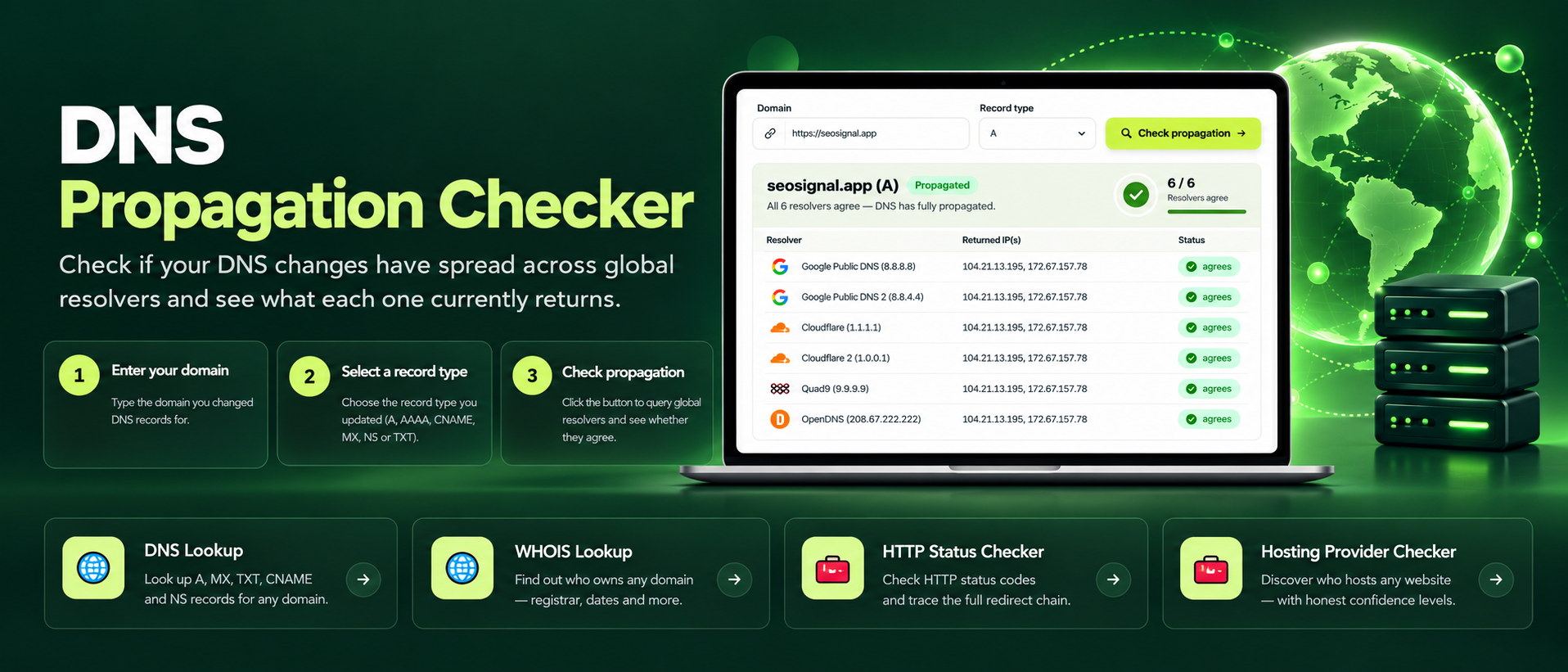
The DNS Propagation Checker by ZaxisMedia removes the guesswork completely. Instead of refreshing your browser and hoping, you get a live verdict: the tool queries six major public resolvers at the same moment, Google, Cloudflare, Quad9 and OpenDNS, and shows you exactly what each one currently returns for your domain. When all six agree, your change is live worldwide. When they disagree, you know propagation is still on its way, and you know exactly which resolvers are lagging behind.
Why this matters
After you change DNS records, propagation decides when the world sees the update. Checking it across the globe takes away the waiting game.
For personal projects
Confirm your domain points to the right server everywhere before you announce a launch or a move.
For business and team use
Diagnose DNS issues for clients region by region, and show stakeholders clear proof that changes have rolled out.
Helpful details
Six major resolvers in one check. Every test queries Google Public DNS (8.8.8.8 and 8.8.4.4), Cloudflare (1.1.1.1 and 1.0.0.1), Quad9 (9.9.9.9) and OpenDNS (208.67.222.222) at the same time, covering the resolvers most visitors actually use.
All common record types. Check A, AAAA, CNAME, MX, NS and TXT records, so one tool covers website moves, IPv6 rollouts, email setup, nameserver changes and domain ownership verification.
Instant propagated verdict. A clear summary tells you whether the resolvers agree. Full agreement means your DNS change has finished propagating and it is safe to move on to the next step.
Per-resolver result table. See exactly what each resolver returned, side by side, so you can spot which locations or providers are still serving stale data instead of guessing.
Built for migrations. It is the perfect companion right after a host migration, a nameserver change, or an email provider switch, the exact moments when wrong DNS data costs real money.
No sign-up, no limits. Run as many checks as you want, completely free, with nothing to install and no account to create. Just enter a domain and check.
Real-time, accurate data. Every query runs live against genuine public resolvers, so you see the true current state of your DNS, not a cached guess or an estimate.
Imagine you run a small online store at shop.example.com and you are moving it from your old shared host to a faster VPS at IP 203.0.113.45. On Monday morning you update the A record. Ten minutes later the store loads perfectly on your phone, but your laptop still shows the old site, and a customer emails saying the checkout page looks different from yesterday. Is the migration broken? You open the DNS Propagation Checker, enter shop.example.com, select record type A, and click check. Within seconds you have the truth: Google and Cloudflare already return 203.0.113.45, while Quad9 and OpenDNS still return the old IP. Four of six resolvers agree, so propagation is in progress and nothing is broken at all. The customer's internet provider simply uses a resolver whose cache has not expired yet. Armed with facts instead of fear, you keep the old server running for the rest of the day and reply to the customer with confidence. On Tuesday morning you re-check: all six resolvers now return 203.0.113.45 with the full "Propagated" badge. Only then do you cancel the old hosting. No customer ever saw an error page, no order was lost, and you never had to guess.
Step-by-step guide
Enter your domain.Type the domain name you changed DNS records for, for example example.com, into the domain field. Double check for typos, since even one wrong character queries a completely different domain.
Select the record type.Choose the type of record you changed. Pick A for a website IP address change, AAAA for IPv6, CNAME for an alias, MX for email routing, NS for a nameserver move, or TXT for verification and email security records.
Click "Check propagation".The tool fires off live queries to all six resolvers simultaneously and gathers their answers within seconds.
Read the verdict.The summary at the top shows the headline result. A "Propagated" badge with full agreement means every resolver returned the same records. A split result means some resolvers are still caching the old data.
Inspect the resolver table.Scroll through the per-resolver breakdown to see exactly what Google, Cloudflare, Quad9 and OpenDNS each returned. This reveals, for instance, that OpenDNS is lagging while everyone else has already updated.
Re-check over time.DNS caches expire gradually, not all at once. Run the check again in an hour or two and watch the agreement converge toward 6 out of 6.
Act with confidence.Only shut down the old server, cancel the old hosting, or announce the move once all resolvers agree. That single habit prevents the most common and most embarrassing migration outages.