WHOIS Lookup: Find Out Who Owns Any Domain Instantly
Free WHOIS lookup for any domain. Check the registrar, registration and expiry dates, name servers and the full WHOIS record instantly, no sign-up needed.
Introduction
Every registered domain name leaves a paper trail. Someone bought it, on some date, through some company, and it expires on some future date. That information lives in a public directory called WHOIS, and reading it is one of the most practical research skills on the internet. Whether you are buying a domain, investigating a suspicious website, or protecting your brand, a WHOIS lookup is usually step one.
Consider how often domain questions come up: you want to buy a domain and need to know when it expires, a phishing email arrives and you want to check whether the sender's domain is legitimate, a competitor launches a new brand and you are curious who is behind it, or you simply cannot remember which registrar holds your own portfolio. In each case, the answer is sitting in the WHOIS record.
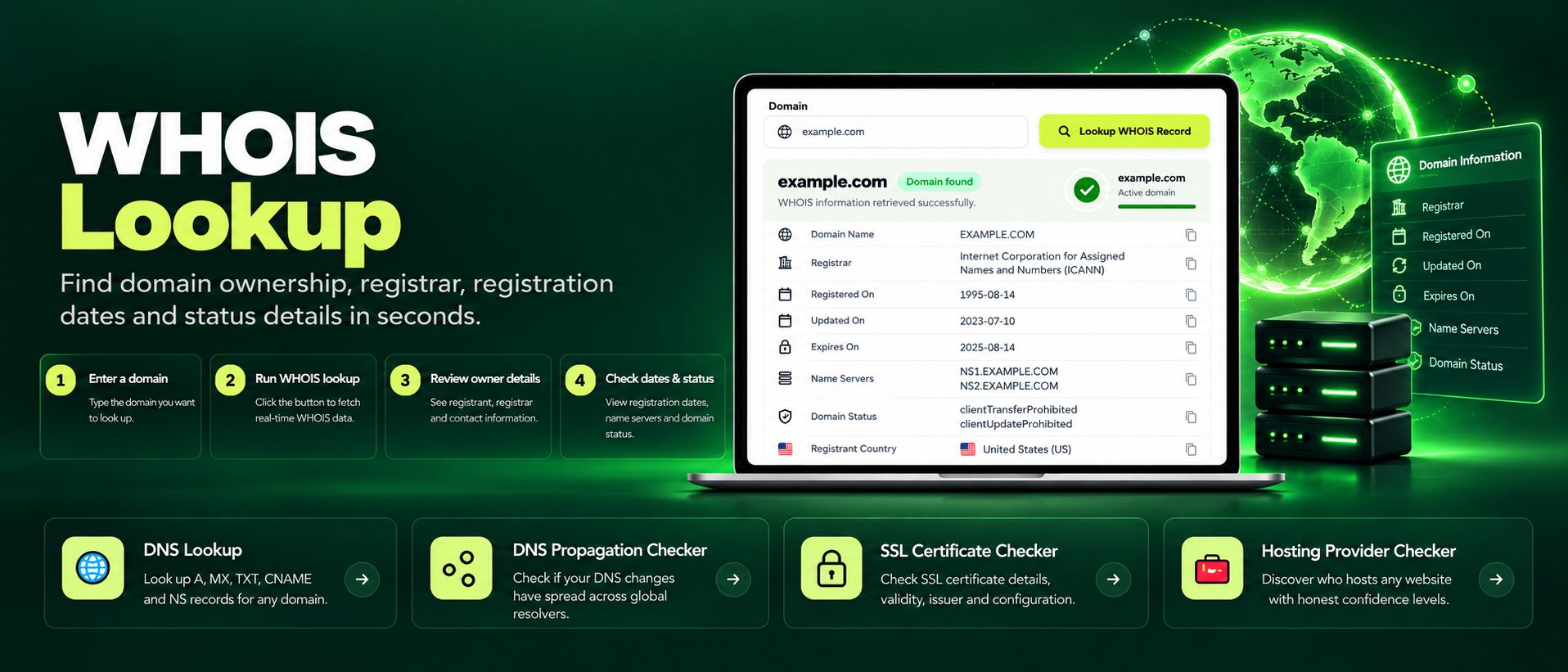
The WHOIS Lookup tool by ZaxisMedia queries the official WHOIS servers, starting at the root and following the referral chain to the responsible registry, and presents the result in a clean summary plus the full raw record. Enter any domain and instantly see its registrar, registration and expiry dates, name servers and status, all free with no sign-up.
Why this matters
Explain the benefits to the reader.
Protect your assets
Domains are business assets, and you cannot manage what you cannot see. Expired domains get snatched up within seconds by drop catchers, so knowing your own portfolio's expiry dates is basic self defense. For brand owners, monitoring lookalike domains, the misspellings and hyphenated versions of your brand, starts with WHOIS: it tells you who registered them and when, which is the foundation of any takedown or purchase negotiation.
Investigate with confidence
For security, WHOIS is an everyday investigative tool. Phishing domains are often registered days before an attack, use privacy protection plus bulletproof registrars, and share name servers with other malicious domains. None of that proves guilt on its own, but a two minute lookup routinely separates a legitimate new business from a throwaway scam domain, and that judgment call protects both companies and their customers.
Helpful details
Official WHOIS data. Queries start at whois.iana.org and follow referrals to the responsible registry, so you get authoritative data, not a third party estimate.
Clear ownership summary. Instantly see the registrar, registration date, expiry date and name servers without digging through raw text.
Full raw record included. Expand the complete WHOIS record when you need every detail, including status codes and registry specific fields.
Expiry date at a glance. Spot soon to expire domains in seconds, essential for domain investors hunting for opportunities and owners avoiding accidental loss.
Registrar identification. See exactly which company manages the domain, useful when you inherit a project and nobody remembers where the domain lives.
Works for any domain. Look up .com, .net, .org, country domains and new extensions, all through the same simple interface.
Free with no sign-up. Unlimited lookups, no account, no tracking of your research. Just answers.
A small business owner receives an email offering to sell her the domain bestcakeshop.pk for what seems like a fair price. Before paying anything, she wants to verify the seller actually owns it and understand what she is buying. A WHOIS lookup takes thirty seconds and tells a clear story. The record shows the domain was registered three years ago through a well known registrar, it expires in nine months, and the name servers point to a standard hosting company. The status codes show no locks that would block a transfer. Everything checks out, so she proceeds, but now she also knows to ask the seller to unlock the domain and provide the transfer authorization code, because the WHOIS status told her exactly what state the domain is in. Contrast that with the alternative: paying first and discovering later that the "seller" had no connection to the domain at all. Domain fraud is common precisely because buyers skip this one free check. A WHOIS lookup does not replace proper escrow for expensive purchases, but it filters out the obvious scams instantly.
Step-by-step guide
Enter the domain name.Type the domain you want to investigate, for example example.com, into the search field. Leave off the http and www parts, just the bare domain.
Click "Look up WHOIS".The tool contacts the official WHOIS servers and follows the referral chain to the registry responsible for that domain's extension.
Read the summary.The top section shows the essentials: registrar name, the date the domain was registered, the date it expires, and the name servers it currently uses.
Check the expiry date first.This single field answers the most common questions: is this domain about to drop, how long has it been registered, and is the owner likely to renew?
Expand the full record.Open the raw WHOIS output for deeper details like domain status codes (clientTransferProhibited and similar), registrar contact handles, and DNSSEC status.
Interpret privacy protection.If the registrant name shows a privacy service instead of a person, that is normal: most registrars now mask personal details. The registrar and dates remain visible and are usually what you actually need.